

In liquid-state NMR experiments, weak signals can be a major challenge. This is especially true when working with small sample quantities, very low concentrations, or nuclei such as 13C and 15N, which have low natural abundance and relatively low gyromagnetic ratios.
Researchers often rely on repeated scans to obtain usable spectra. For natural-abundance 2D experiments such as INADEQUATE, data acquisition can take more than ten hours or even several days. Even after spending considerable instrument time, weak signals may still be buried in background noise.
Improving sensitivity has therefore remained a key goal in NMR hardware development and experimental methods. In this guide, we look at the common ways to improve NMR sensitivity, how cryogenic probes reduce receiver noise, and what these improvements mean for everyday research.
1. Common Ways to Improve NMR Sensitivity
NMR sensitivity is not determined by a single component. Sample conditions, magnetic field strength, probe performance, pulse sequences, and receiver-chain characteristics all contribute to the quality of the final spectrum.
In general, sensitivity can be improved through three main approaches.
1.1 More Scans and Better Data Processing
The most straightforward approach is to increase the number of scans. The accumulated NMR signal increases linearly with the number of scans (N), while random noise increases approximately with the square root of N. As a result, the signal-to-noise ratio (SNR) improves in proportion to √N.
Data processing methods, including window functions and baseline correction, can also improve the appearance of a spectrum.
- Advantage: No additional hardware is required, and the method can be used with existing NMR systems.
- Trade-off: More scans mean longer acquisition times. Excessive window-function processing can also sacrifice spectral resolution and alter peak shapes.
1.2 Pulse Sequence Optimization and Polarization Transfer
Pulse sequence design provides another way to improve sensitivity. One of the most widely used techniques is polarization transfer.
Polarization transfer moves spin polarization from a more sensitive nucleus, such as 1H, to a less sensitive nucleus, such as 13C or 15N, increasing the signal amplitude of the target nucleus.
Classic pulse sequences such as INEPT and DEPT use this principle. Heteronuclear 2D experiments such as HSQC and HMBC also use the 1H detection channel to collect signals, transferring heteronuclear spectral information to the more sensitive proton channel for indirect detection.
If relaxation and pulse losses are ignored, the theoretical upper limit for the target nucleus signal amplitude relative to thermal equilibrium is approximately the ratio of the gyromagnetic ratios (γH/γX). This corresponds to approximately:
- 4× for 13C
- 10× for 15N
These values represent theoretical signal-amplitude limits, not the actual SNR improvement of an entire experiment. Real performance also depends on relaxation, coupling, pulse efficiency, and the detection channel.
1.3 Hardware Upgrades
Hardware improvements can deliver more substantial sensitivity gains. There are three main directions to consider.
Increasing Magnetic Field Strength
A stronger magnetic field increases the energy separation between nuclear spin states and raises the thermal-equilibrium spin polarization. This directly increases the NMR response signal. Higher field strength also improves chemical shift dispersion, making it an important factor in NMR system performance.
For example, proton resonance frequencies have progressed from 400 MHz and 600 MHz to 800 MHz and even 1 GHz-class high-field systems.
The trade-off is the substantial cost of the equipment and facility. Relaxation behavior and linewidth conditions may also change with field strength.
Improving Probe Design
- Large-bore probes: A larger probe, such as a 10 mm probe, can increase the effective detection volume and the total number of contributing spins when sufficient sample is available. This can increase the absolute signal strength. However, shimming becomes more challenging and more sample is required.
- Inverse probes: These optimize sensitivity through coil geometry. When 1H observation is the main focus, placing the proton observation coil in the innermost position, closest to the sample, can significantly improve proton detection sensitivity.
- Cryogenic probes: These improve sensitivity by reducing noise in the receiver system. Instead of changing the sample itself, they cool the RF coil and front-end receiver chain to reduce thermal noise at its source.
Introducing External Polarization: Dynamic Nuclear Polarization (DNP)
DNP uses microwave irradiation to transfer the high polarization of electron spins to nuclear spins. Based on a simplified theoretical estimate, the upper limit of sensitivity enhancement is related to the ratio of the electron and nuclear gyromagnetic ratios (γe/γn).
The theoretical maximum enhancement can reach approximately 660× for 1H and 2,600× for 13C.
However, DNP requires specialized equipment, including a microwave source, a dedicated probe, and free-radical polarizing agents. Many systems also operate below 100 K, with some methods requiring temperatures near the liquid-ammonia range.
2. How Do Cryogenic NMR Probes Improve Sensitivity?
In conventional room-temperature NMR probes, the RF coil, tuning and matching circuits, and preamplifier all operate near room temperature. The random thermal motion of electrons in conductors generates Johnson-Nyquist thermal noise, which is an important source of background noise in the receiver chain.
A cryogenic probe addresses this problem by placing key components, including the RF coil, tuning and matching network, and preamplifier, inside a vacuum-insulated, ultra-low-temperature region.
For example, the RF coil in CIQTEK's CryoHe series cryogenic NMR probes can operate at temperatures as low as approximately 20 K.
One important point needs to be clarified: a cold probe does not mean a cold sample.
The components cooled in a cryogenic probe are the RF coil and front-end receiver chain, not the sample itself. The sample tube is separated from the cold region by vacuum and thermal insulation. Its temperature is controlled independently:
- For room-temperature experiments, the sample remains at room temperature.
- For variable-temperature experiments, the sample operates at the temperature set by the independent temperature-control system.
Two Main Effects of Cryogenic Cooling
1. Lower Noise from the RF Coil
As the coil temperature decreases, the electrical resistivity of the conductor drops, reducing thermal noise. The coil's Q factor also increases, resulting in lower transmission losses when receiving the same nuclear magnetization.
2. Lower Noise from Front-End Electronics
Cooling components such as the preamplifier significantly reduces their noise figure, lowering the background noise entering the receiver.
Think of it this way: it is difficult to hear a quiet sound in a noisy environment. Once you move into a quiet room, the same sound becomes much easier to hear. A cryogenic probe creates a quieter, lower-loss receiver chain, allowing weak NMR signals to stand out more clearly against the background.
Important note: The actual sensitivity improvement cannot be calculated simply by comparing 300 K and 20 K. Coil resistance, sample losses, matching conditions, and receiver bandwidth all affect the final result. Sample losses caused by aqueous solutions, salts, and buffer solutions do not disappear when the coil is cooled.
3. What Can Higher NMR Sensitivity Do for Your Research?
For researchers and university NMR facilities, the practical value of higher sensitivity can be seen in three main areas.
3.1 Detect Weaker Signals
Low-concentration samples, small quantities of synthetic products, and nuclei with very low natural abundance can produce signals that are easily buried in background noise. With a higher SNR, these weak signals become easier to identify and analyze. This helps researchers obtain usable spectral data while avoiding unnecessary consumption of valuable samples and instrument time.
3.2 Significantly Reduce Acquisition Time
When random noise is dominant and other experimental conditions remain unchanged, signal averaging over N scans increases SNR approximately in proportion to √N.
Therefore, the acquisition time required to reach a target SNR is proportional to the square of that target SNR:
t ∝ SNR2
This means that if a cryogenic probe provides a 3× SNR improvement under the same acquisition conditions, the theoretical acquisition time required to reach the same target SNR can be reduced from 9 hours to approximately 1 hour, assuming the experiment duration is mainly determined by repeated scans and the number of indirect-dimension increments remains unchanged.
The theoretical relationship is summarized below:
| SNR Improvement | Time Required for the Same SNR |
|---|---|
| 2× | Approximately 1/4 |
| 3× | Approximately 1/9 |
| 5× | Approximately 1/25 |
Note: These are theoretical estimates. Actual time savings also depend on T1 relaxation, recycle delays, the number of 2D increments, and sample stability.
3.3 Understand the Difference Between SNR and Resolution
It is important to understand that higher SNR does not automatically mean higher spectral resolution. Cryogenic probes improve the signal-to-noise ratio, not the intrinsic separation of spectral lines. If sample purity is poor, peaks overlap severely, or the lines are inherently broad, reducing background noise alone cannot separate them. Proper sample preparation, shimming, tuning and matching, and pulse sequence optimization remain essential for obtaining high-quality spectra.
4. CIQTEK CryoHe Series: Improved Sensitivity for Weak NMR Signals
Improving sensitivity remains a key direction in NMR technology development and an important way for researchers to push detection limits and improve experimental efficiency.
CIQTEK's independently developed CryoHe series helium cryogenic NMR probes are designed to keep the core RF receiving coil at an ultra-low temperature of approximately 20 K, helping suppress thermal noise in the detection circuit at its source.
Compared with conventional room-temperature probes, the CryoHe series can typically provide approximately 2× or higher SNR for nuclei such as 1H and 13C. Under the same target SNR requirement, acquisition time can be shortened by roughly an order of magnitude, depending on the experimental conditions.
For experiments involving weak signals, low-concentration samples, or time-consuming 2D measurements, this improvement can make a meaningful difference to data collection and analysis efficiency.
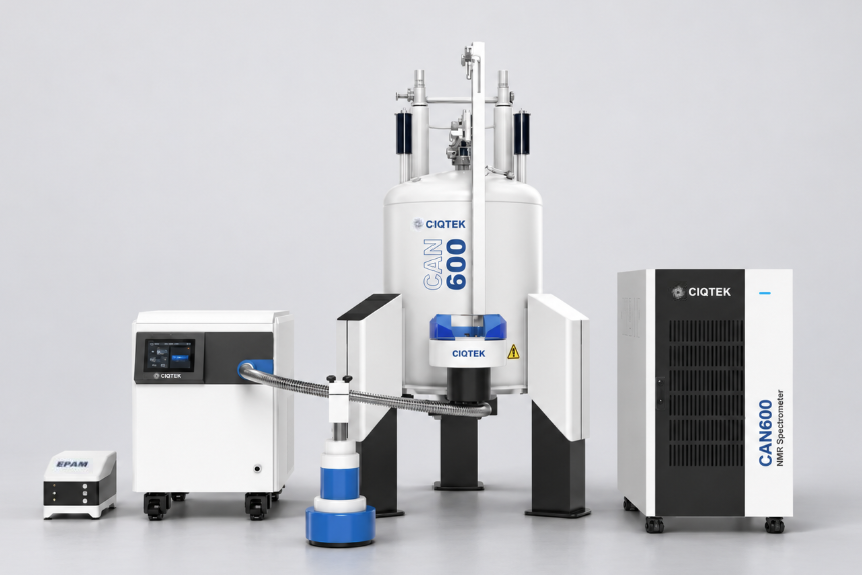
Figure. CIQTEK CryoHe Series Helium Cryogenic NMR Probe